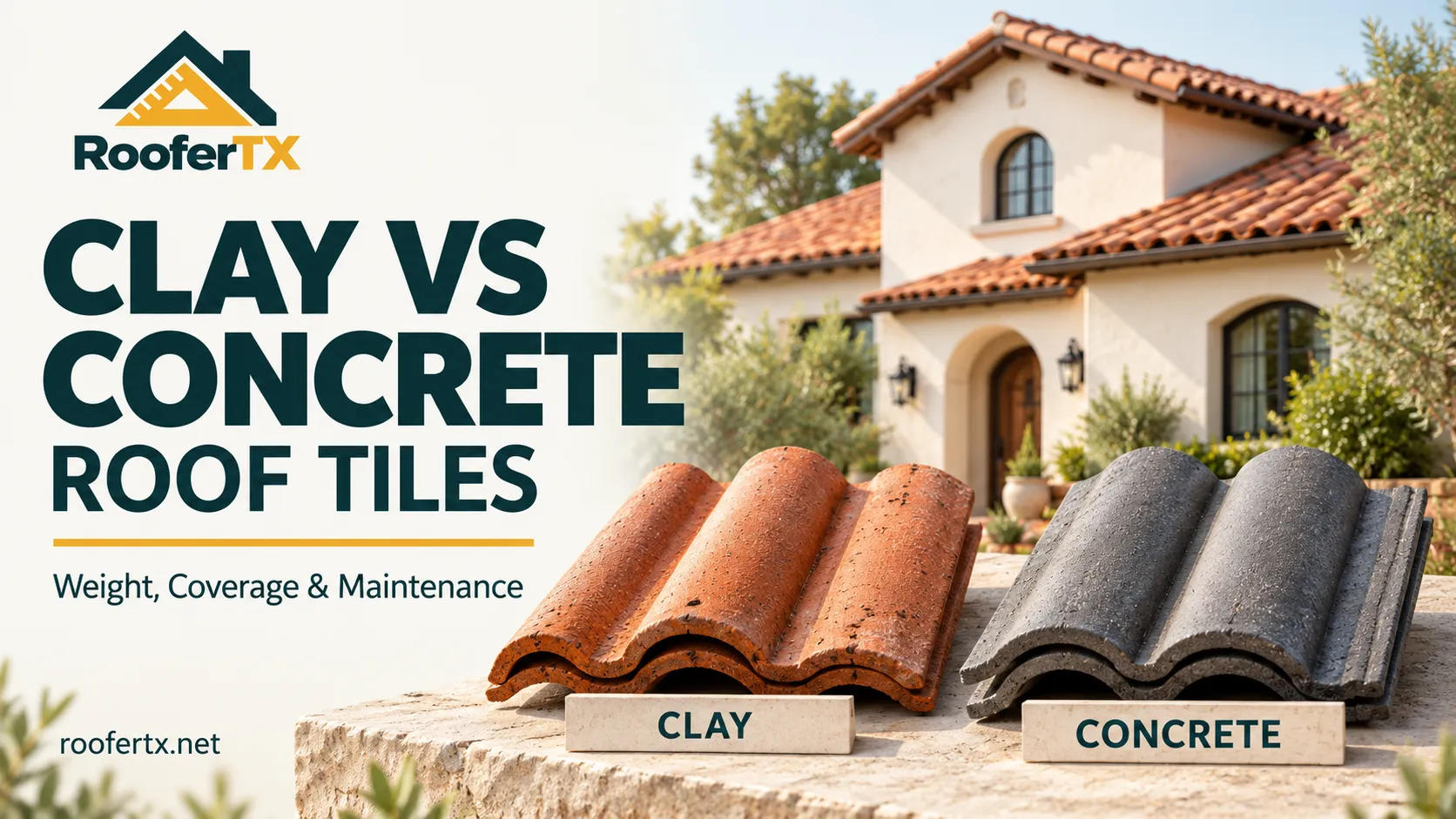
Clay vs concrete roof tiles is a choice between two durable roofing materials with different manufacturing methods, finishes, and product specifications. The right option depends on your roof structure, preferred appearance, local conditions, and complete installation cost.
Do not choose from a lifespan chart or price per tile alone. A useful comparison checks how much installed area each product covers, its weight over that area, and the components needed beneath it.
This guide explains those differences and shows how to compare two tile-roof quotations fairly.
Clay vs Concrete Roof Tiles: Which Is Better?
Neither material is best for every roof. Clay may suit a project that prioritizes a particular fired finish or architectural style. Concrete may offer a suitable profile and finish within the available budget.
Both choices still need product-specific checks for roof slope, structural capacity, installation details, and exposure conditions.
| Factor | Clay roof tiles | Concrete roof tiles |
|---|---|---|
| Basic material | Shaped clay hardened by firing | Molded cement-based mixture |
| Appearance | Natural, colored, or glazed finishes, depending on product | Different profiles, pigments, and surface finishes |
| Installed weight | Depends on profile and coverage | Depends on profile and coverage |
| Quantity required | Use published installed coverage | Use published installed coverage |
| Weather suitability | Check the selected product and assembly | Check the selected product and assembly |
| Maintenance | Inspect the complete roofing system | Inspect the complete roofing system |
| Cost | Compare a complete project quotation | Compare a complete project quotation |
The practical question is: Which approved tile system meets your project requirements at a cost you can support?
Appearance: Compare Real Samples, Not Just Material Names
Clay roofing is not limited to orange barrel tiles, and concrete roofing is not limited to gray flat tiles. Both categories include different shapes, colors, and profiles. Tile Roofing Industry Alliance
Ask to see a sample of the exact product and color blend being quoted. If possible, view an installed roof using that product.
Look at:
- Profile depth and the shadows it creates.
- Color variation between individual tiles.
- Surface texture and finish.
- Matching ridge, hip, and edge pieces.
- Compatibility with the building’s architectural style.
For repairs, matching the profile matters as well as matching the color. Two tiles that look similar from the street may not fit together correctly.
Clay vs Concrete Roof Tiles: Compare Installed Weight
Weight per tile and weight per roof area are different measurements.
A lighter individual tile may require more pieces to cover the same area. This can make its installed weight higher than expected.
When comparing products, request weight in one consistent unit:
- Pounds per square foot.
- Pounds per roofing square.
- Kilograms per square meter.
One roofing square equals 100 square feet.
Why Product Specifications Matter
For example, Ludowici lists its French clay tile at 1,025 pounds per square, with 133 pieces per square. That figure describes one particular clay product—not every clay roof tile. Interlocking Tile
Ask the supplier what the published weight includes. Field-tile weight may not represent the entire installed assembly.
Decking, underlayment, battens where required, attachments, and other components also need consideration.
A Simple Weight Comparison
Suppose two suitable products have these hypothetical installed tile weights:
| Measurement | Tile A | Tile B |
|---|---|---|
| Weight per roofing square | 850 lb | 1,000 lb |
| Roof area | 20 squares | 20 squares |
| Tile weight over that area | 17,000 lb | 20,000 lb |
The difference is 3,000 pounds of tile weight.
This calculation illustrates the difference between products. It does not establish whether the building can support either assembly.
Before converting from another roof covering, have the proposed loads and existing structure assessed.
How to Calculate Tile Coverage and Quantities
Use the manufacturer’s installed coverage, rather than multiplying the tile’s overall length by its width.
Tiles overlap. The portion hidden beneath neighboring tiles does not provide additional exposed roof coverage.
Start with the actual sloped roof area. The Roof Area Calculator can help establish that measurement.
Clay vs Concrete Roof Tiles: Coverage Calculation
When the manufacturer gives pieces per square:
Field tiles required = roof area ÷ 100 × pieces per square × waste factor
Round up to whole tiles, then account for the supplier’s pack or pallet quantities.
Clay vs Concrete Roof Tiles: Worked Ordering Example
Assume:
- Sloped roof area: 2,000 square feet
- Published installed coverage: 90 field tiles per square
- Illustrative cutting and breakage allowance: 8%
First, convert the area:
2,000 ÷ 100 = 20 roofing squares
Then calculate the base quantity:
20 × 90 = 1,800 field tiles
Apply the allowance:
1,800 × 1.08 = 1,944 field tiles
The preliminary order is 1,944 field tiles, before pack rounding and separately specified accessories.
The 8% allowance is an example. Roof complexity, handling, cuts, and usable offcuts affect the appropriate allowance.
Use the Roof Tile Calculator to organize your quantity estimate.
What the Field-Tile Calculation Leaves Out
Estimate these items separately where the system requires them:
- Hip and ridge tiles.
- Verge or rake pieces.
- Eave closures and starter details.
- Special junction fittings.
- Fasteners, clips, or other approved attachments.
- Replacement stock for future repairs.
Do not assume a field-tile waste allowance also covers all these components.
Roof Pitch and Climate: Check the Actual System
A tile’s material does not establish its minimum roof pitch or storm performance.
The profile, overlaps, attachments, underlayment, and regional installation requirements all matter.
Use the Roof Pitch Calculator if you need to identify the slope before discussing product suitability.
For U.S. projects, the Tile Roofing Industry Alliance installation guides include guidance for concrete and clay tile systems, with separate resources for high-wind and cold-weather applications. Check the tile manufacturer’s additional requirements as well.
Ask for documentation that addresses your project’s conditions rather than accepting a general statement such as “clay handles frost” or “concrete withstands hurricanes.”
A published rating applies under its stated testing and installation conditions.
Lifespan: Separate the Tiles from the Complete Roof
A long-lived tile does not guarantee that every component beneath it will last equally long.
When comparing clay vs concrete roof tiles, ask separate questions about:
- The tile product and its warranty.
- Underlayment selection.
- Flashing and roof penetrations.
- Attachment details.
- Inspection and repair access.
A tile warranty is not automatically a warranty against every roof leak. Read its coverage, exclusions, and any labor provisions.
Avoid budgeting on a fixed claim that every clay roof lasts a certain number of years or every concrete roof needs replacement on a set date.
The condition of the installed system matters more than a generic countdown.
Maintenance: Low Maintenance Does Not Mean No Inspection
Both roofs benefit from checking damaged tiles, drainage paths, flashings, and penetrations.
Eagle Roofing notes that missing or broken concrete tiles can expose underlayment to weather and that repairs may range from individual tile replacement to more extensive work, depending on the condition.
Arrange inspections appropriate to the roof’s condition and after suspected storm or impact damage.
Cleaning and Surface Changes
Use the selected manufacturer’s cleaning guidance. Do not assume aggressive pressure washing, sealing, or coating is necessary.
Concrete tiles can develop efflorescence, a whitish mineral deposit. TRI Alliance describes this as a discoloration that does not itself damage the tile and often fades naturally.
Appearance changes and roof failure are not the same thing. Have the cause identified before paying for a treatment.
Roof access and cleaning should be handled by people experienced with tile roofs; walking and cleaning can introduce both fall risks and tile damage.
Compare Total Cost, Not Price per Tile
A lower unit price can be misleading when two products have different coverage.
Consider this hypothetical example:
| Item | Product A | Product B |
|---|---|---|
| Price per field tile | $5.00 | $4.00 |
| Field tiles per square | 90 | 120 |
| Field-tile cost per square | $450 | $480 |
Product B costs less per tile but more per covered square.
These figures are illustrative, not current market prices. They exclude waste, accessories, and installation.
For a complete quotation, compare the same scope:
- Roof area and selected product.
- Removal and disposal.
- Deck repairs and any structural work.
- Underlayment and flashing.
- Field tiles and special fittings.
- Attachments and labor.
- Delivery, access, and cleanup.
The Roofing Estimate Builder can help organize these costs into comparable line items.
Frequently Asked Questions
Are clay roof tiles always lighter than concrete tiles?
No. Compare published installed weight for the exact products. Tile size, profile, and pieces required per square affect the result.
Are concrete roof tiles always cheaper?
Not necessarily. Compare cost per covered area and total installation scope. Price per tile alone can give the wrong impression.
Which tile is better for a cold climate?
Choose a product and installation system documented for the relevant conditions. Material category alone does not establish freeze-thaw suitability.
Can a tile roof leak when the tiles look fine?
Yes. A leak may involve flashing, underlayment, penetrations, or installation details. An intact-looking surface does not rule out problems elsewhere in the assembly.
Should I keep spare roof tiles?
Ask your contractor about suitable replacement stock. Record the manufacturer, product name, profile, and color so future repairs are easier to match.
Can I replace concrete tiles with clay tiles without changing anything else?
Do not assume so. Check the proposed weight, coverage, attachment details, pitch requirements, and condition of the existing roof assembly first.