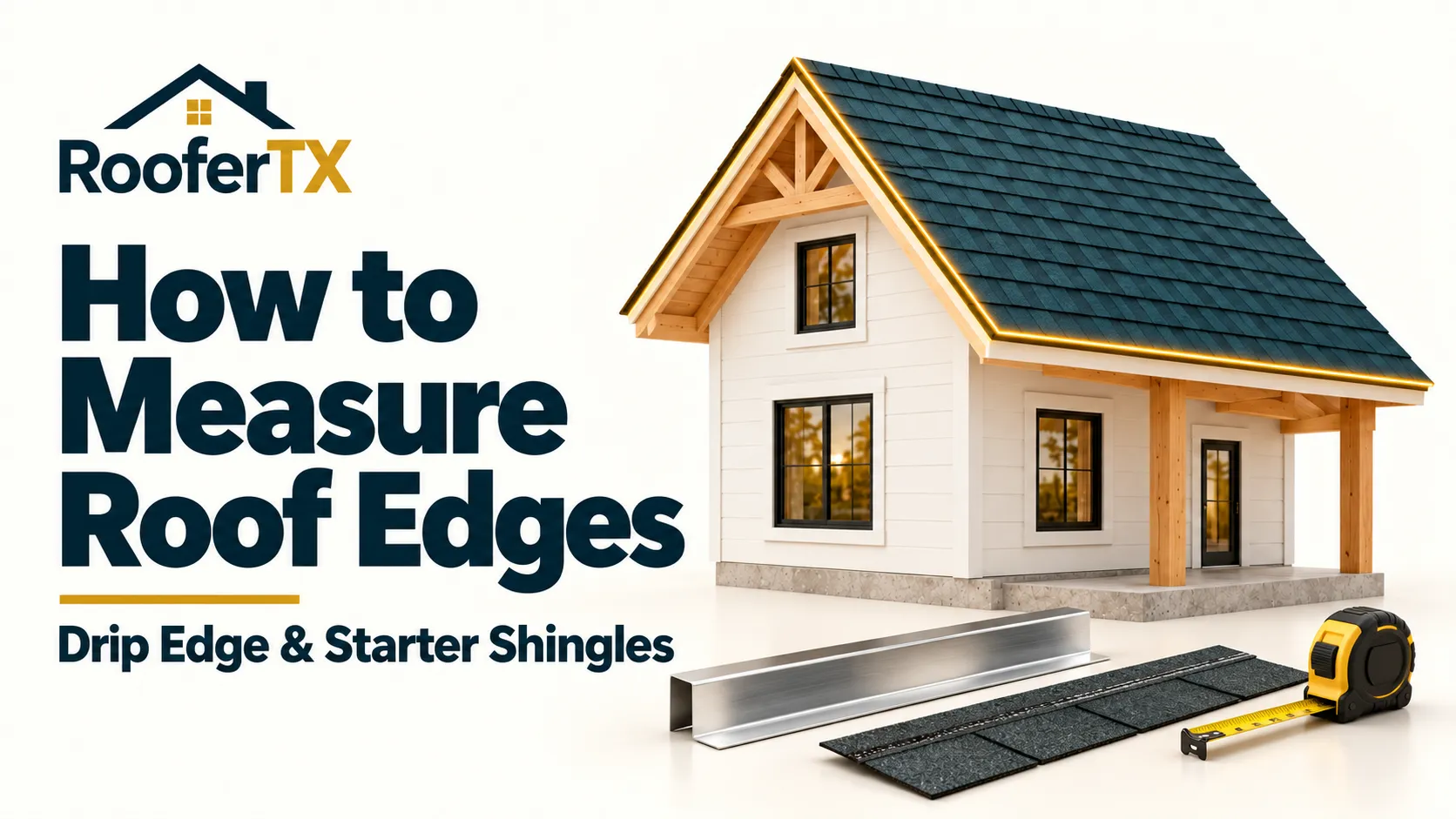
Knowing how to measure roof edges helps you estimate drip edge and starter shingles without confusing roof perimeter with roof area.
Start by recording each eave and rake separately. Measure horizontal eaves along their actual length, use the true sloped length for rakes, and identify which edges need each product.
Then calculate the quantities separately:
- Drip edge: Use individual edge lengths, stock-piece length and specified joint overlap.
- Starter shingles: Use the required edge length and the selected product’s stated linear coverage.
Both products are estimated using length, but they do not necessarily use the same purchasing formula.
How to Measure Roof Edges: Identify Eaves and Rakes
Before measuring, sketch the roof and label its outside edges.
An eave is the lower edge where a roof slope ends. On a simple gable roof, the two long lower edges are eaves.
A rake is the sloping outside edge at a gable end. A simple gable roof normally has four rake runs: two at each end.
| Roof feature | Description | How to record it |
|---|---|---|
| Eave | Lower edge of a roof plane | Actual horizontal edge length |
| Rake | Sloping edge at a gable end | Actual sloped edge length |
| Ridge | Upper line where roof planes meet | Separate ridge measurement |
| Valley | Internal intersection between roof planes | Separate valley measurement |
Do not add ridges or valleys to an eave-and-rake total. Their materials are estimated separately.
A simple hip roof has eaves around its perimeter and no gable rakes. Dormers, porches and extensions can introduce additional edges.
Prepare a Roof-Edge Worksheet
Assign an identifier to every run, such as E1 for the first eave or R1 for the first rake.
Record:
- The edge type.
- Its measured or calculated length.
- Whether the measurement includes roof overhangs.
- Whether drip edge is specified there.
- Whether starter shingles are specified there.
Use plans, a reliable measurement report or safely obtainable measurements. Do not climb onto the roof solely to complete an estimating worksheet.
Measure Eaves Along the Actual Roof Edge
For a simple level eave, record the distance from one end of the roof edge to the other.
Do not automatically use the wall length. Roof extensions beyond the gable walls can make the eave longer than the building.
For example:
Wall length = 40 feet
Roof extension beyond each gable wall = 1 foot
Eave length = 40 + 1 + 1 = 42 feet
If both eaves are identical:
Total eave length = 42 × 2 = 84 feet
When a measurement already runs from roof edge to roof edge, do not add those extensions again.
Measure Rakes Along Their Slope
A rake rises toward the ridge, so its horizontal projection is shorter than its actual length.
If you know the horizontal run and roof pitch, calculate:
Rake length = horizontal rake projection × pitch multiplier
For a pitch expressed as rise per 12:
Pitch multiplier = √[1 + (pitch ÷ 12)²]
At 6/12 pitch, the multiplier is approximately 1.118034.
If a rake’s horizontal projection is 16 feet:
16 × 1.118034 ≈ 17.8885 feet
The actual rake length is approximately 17.89 feet.
Use the Roof Pitch Calculator to find the multiplier for your roof.
If your report already gives the actual sloped rake length, use that figure directly. Applying the multiplier again would overestimate it.
How to Measure Roof Edges on a Simple Gable Roof
Consider a symmetrical gable roof with these confirmed dimensions:
| Input | Value |
|---|---|
| Roof footprint length, including overhangs | 42 ft |
| Roof footprint width, including overhangs | 32 ft |
| Roof pitch | 6/12 |
| Number of eaves | 2 |
| Number of rake runs | 4 |
Each eave is 42 feet long.
Each rake has a horizontal projection of half the roof width:
32 ÷ 2 = 16 feet
Each sloped rake is:
16 × 1.118034 ≈ 17.8885 feet
The edge totals are therefore:
| Edge group | Calculation | Total |
|---|---|---|
| Eaves | 2 × 42 | 84.00 ft |
| Rakes | 4 × 17.8885 | 71.55 ft |
| Combined eaves and rakes | 84 + 71.5542 | 155.55 ft |
How to Measure Roof Edges Without Double Counting
The four rake runs already include both slopes at both gable ends. Do not double their total again.
Similarly, the example dimensions already include overhangs. Adding another allowance for those same overhangs would count them twice.
Keep each run on the worksheet even after calculating the combined total. Individual lengths remain important when estimating metal pieces.
Turn Edge Measurements into Drip Edge Quantities
Knowing how to measure roof edges gives you the required coverage. The next step is accounting for stock lengths and overlaps.
Where pieces overlap, their combined coverage is less than their combined purchased length.
For a straight run:
Coverage = number of pieces × piece length − number of joints × overlap
A run using three pieces has two straight-run joints.
Drip Edge Example with Separate Runs
Continue with the gable-roof example and assume:
- Drip edge is specified on all six runs.
- Stock pieces are 10 feet long.
- Joint overlap is an illustrative 2 inches.
- Each run starts with new stock pieces.
- Offcuts are not reused between runs.
The overlap is a calculation input, not a universal installation recommendation.
For one 42-foot eave:
Four pieces cover: 40 − (3 × 2/12) = 39.5 feet
That is insufficient.
Five pieces cover: 50 − (4 × 2/12) ≈ 49.33 feet
For one 17.89-foot rake:
Two pieces cover: 20 − 2/12 ≈ 19.83 feet
The resulting allocation is:
| Edge | Number of runs | Pieces per run | Total pieces |
|---|---|---|---|
| 42-foot eaves | 2 | 5 | 10 |
| 17.89-foot rakes | 4 | 2 | 8 |
| Base quantity | 6 | — | 18 |
This estimate excludes separate corner details and additional spares. A planned cutting layout might reuse suitable offcuts and change the purchase quantity.
The Drip Edge Calculator calculates each run separately, includes the overlap you enter and does not share offcuts between runs. RooferTX
Calculate Starter Shingles from Linear Coverage
Starter shingles should be estimated using the edges required by the selected roofing system.
Do not assume starter belongs only along the eaves. Check the manufacturer’s instructions for rake-edge requirements and product compatibility.
For a product example, GAF Pro-Start starter strip shingles are intended for eave and rake applications. GAF lists approximately 120.33 linear feet of coverage per bundle. GAF Roofing
Using the example roof’s combined edge length:
155.55 ÷ 120.33 ≈ 1.29 bundles
Round up to a whole package:
Base purchase quantity = 2 bundles
That is a coverage estimate before checking layout losses and any specified additional allowance. The unused nominal coverage after rounding is not automatically a guarantee that every cut will work.
Use your selected product’s coverage—not a generic field-shingle bundle figure—in the Starter Shingle Calculator.
Why Drip Edge and Starter Need Separate Calculations
Even when both products follow the same edges, their order quantities differ.
Drip edge is purchased in rigid lengths. Joint overlaps, individual runs, corner details and reusable offcuts affect the piece count.
Starter shingles are commonly purchased by bundle or roll with stated linear coverage. Their quantity depends on the product’s usable coverage and required layout.
Keep both separate from field shingles, which are primarily estimated from roof surface area. Use the Roof Shingle Calculator for that part of the project.
Common Roof-Edge Measuring Mistakes
Using square feet instead of linear feet.
Roof area cannot tell you the exact perimeter. Two roofs with the same area can have different edge lengths.
Using the building perimeter as the roof perimeter.
Overhangs and sloped rakes change the result.
Using horizontal measurements for rakes.
Convert projected rake runs into sloped lengths when necessary.
Dividing the total perimeter by metal stock length and stopping there.
This ignores joints, separate runs and cutting arrangements.
Adding the same allowance twice.
Record whether overlaps, cutting allowances or spares are already included.
Assuming every starter bundle has identical coverage.
Use the current packaging or product specification.
Frequently Asked Questions
How Do You Measure Roof Edges for Drip Edge?
Record each required eave and rake run separately. Use actual sloped lengths for rakes, then calculate pieces using stock length, specified overlap and the planned cutting layout.
Are Roof Edges Measured in Linear Feet or Square Feet?
Use linear feet or linear metres. These measure length. Square feet and square metres measure roof surface area.
Do You Include Rakes When Estimating Starter Shingles?
Include rakes when required by the selected product and roofing-system instructions. Do not assume an eaves-only quantity without checking.
Can You Measure Roof Edges from the Ground?
You can estimate accessible roof geometry using verified dimensions, overhangs and pitch. Complex or hidden edges may require plans or a professional measurement report.
Does a Gutter Measurement Give the Full Roof Perimeter?
Usually not. Gutters commonly follow eaves, while gable rake edges slope toward the ridge. A gutter total can therefore omit edges needed for roofing materials.
Should You Add a Fixed Waste Percentage?
There is no single percentage suitable for every layout. Calculate required coverage and overlaps first, then assess cuts, corners and spares without repeating allowances already included.
Once the worksheet is complete, keep the eave and rake totals visible in your estimate. That makes it easier to check the selected products, compare quantities and explain how the order was calculated.