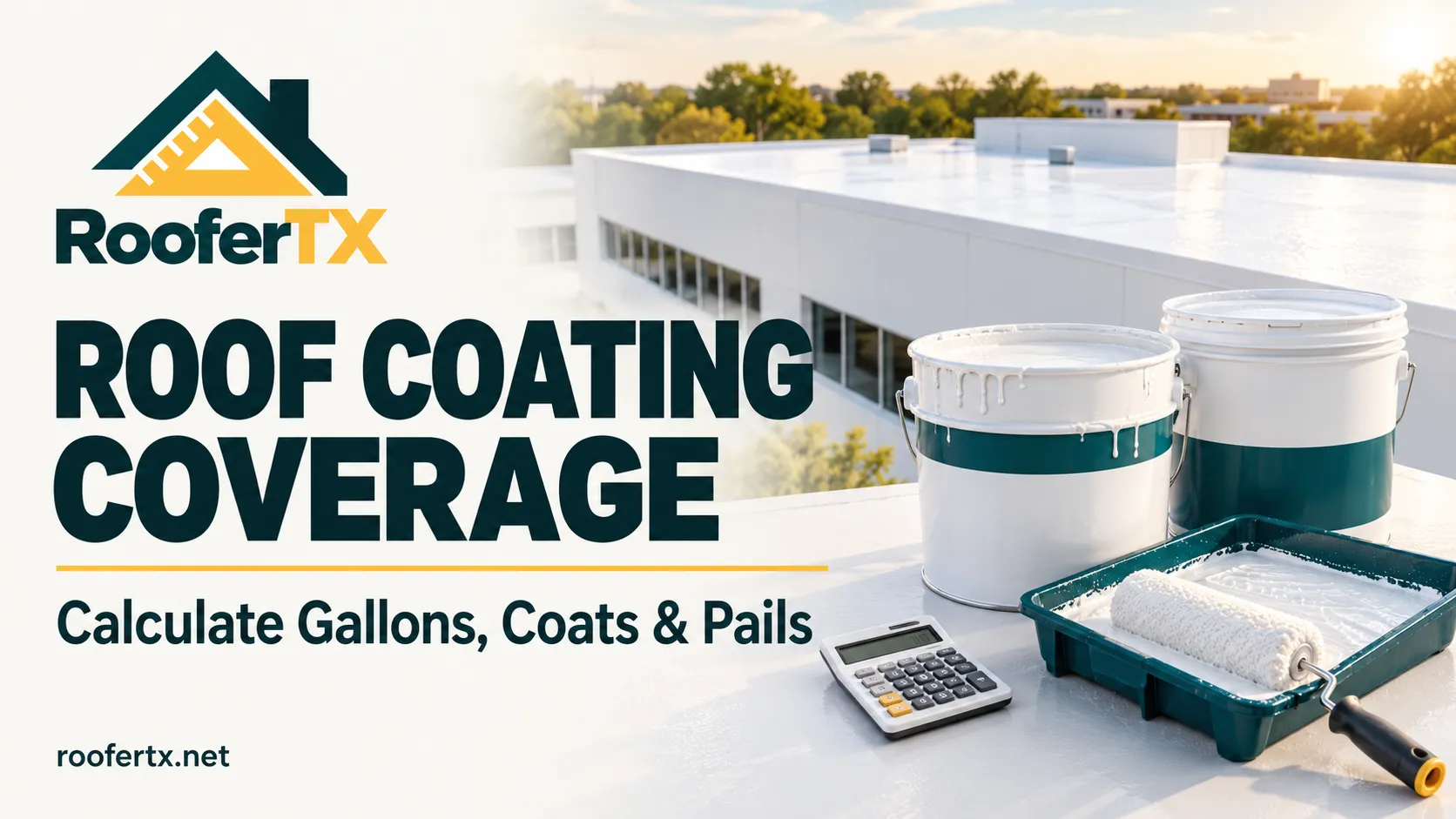
Roof coating coverage tells you how much surface a specified amount of coating can cover at the required application thickness. To estimate the quantity correctly, you need the roof area, product application rate, number of coats, and actual container size.
The most important distinction is whether the published rate applies to each coat or to the complete coating system. Mixing those up can double your order—or leave you with only half the material needed.
This guide explains the calculations with examples you can adapt to your selected product.
How Do You Calculate Roof Coating Coverage?
When the product lists square feet per gallon per coat, use:
Gallons required = roof area × number of coats ÷ coverage per gallon
For example:
1,000 sq. ft. × 2 coats ÷ 100 sq. ft. per gallon = 20 gallons
That is the basic quantity before any justified allowance or container rounding.
If the data sheet instead gives a total-system rate, use that total once. Do not multiply it by the number of coats again.
You can enter your measurements and product rate into the Roof Coating Calculator to check an initial estimate.
Read the Coverage Units Before Calculating
Roof coating labels do not all express coverage the same way.
| Published rate | What it means | Calculation |
|---|---|---|
| 100 sq. ft. per gallon per coat | One gallon covers 100 sq. ft. for one coat | Area ÷ 100 × coats |
| 1.5 gallons per 100 sq. ft. per coat | Each coat uses 1.5 gallons per roofing square | Area ÷ 100 × 1.5 × coats |
| 3 gallons per 100 sq. ft. total | Entire specified system uses 3 gallons per square | Area ÷ 100 × 3 |
| 24 dry mils | Required cured-film thickness | Use the manufacturer’s corresponding application specification |
One roofing square equals 100 square feet.
This article uses U.S. gallons. Do not substitute Imperial gallons without converting the quantities.
Convert Between Common Coverage Rates
To convert gallons per 100 square feet into square feet per gallon:
Coverage per gallon = 100 ÷ gallons per 100 sq. ft.
For example:
100 ÷ 1.5 = approximately 66.7 sq. ft. per gallon
A lower square-feet-per-gallon figure means more coating is applied over the same area.
It does not automatically mean the product is worse value. The required thickness and system performance may differ.
Roof Coating Coverage for One Coat vs Two Coats
The number of coats changes the estimate only when the rate is stated per coat.
Suppose the specification calls for two coats, each at 1.5 gallons per 100 square feet.
The complete system uses:
1.5 + 1.5 = 3 gallons per 100 square feet
If another document already states “3 gallons per 100 square feet total,” that describes the same total quantity. Multiplying it by two would count the coats twice.
Roof Coating Coverage When Coat Rates Differ
Some specifications use different products or different rates for individual layers.
Calculate each layer independently:
Total gallons = first-layer gallons + second-layer gallons + additional-layer gallons
If the layers use different products, keep their purchase quantities separate. You cannot combine leftover primer and topcoat to satisfy a total gallon requirement.
Roof Coating Coverage: Worked Two-Coat Example
Assume a hypothetical project requires:
- Roof area: 1,600 square feet
- First coat: 1.5 gallons per 100 square feet
- Second coat: 1 gallon per 100 square feet
Calculate each coat:
| Layer | Calculation | Quantity |
|---|---|---|
| First coat | 1,600 ÷ 100 × 1.5 | 24 gallons |
| Second coat | 1,600 ÷ 100 × 1 | 16 gallons |
| Combined coating | 24 + 16 | 40 gallons |
With an illustrative 10% purchasing allowance:
40 × 1.10 = 44 gallons
If both coats use the same product in actual 5-gallon containers:
44 ÷ 5 = 8.8
Round up to 9 containers, providing 45 gallons.
These are example inputs, not application recommendations. Use the selected system’s rates and permitted coat sequence.
Check Actual Pail Contents Before Ordering
“Five-gallon size” and “five gallons of product” are not always equivalent descriptions.
Use the net contents printed on the label, rather than assuming every large pail contains exactly five gallons.
For a 44-gallon order:
| Actual contents per pail | Calculation | Pails required |
|---|---|---|
| 5 gallons | 44 ÷ 5 = 8.8 | 9 |
| 4.75 gallons | 44 ÷ 4.75 ≈ 9.26 | 10 |
Round only after using the correct container size.
For separate primer, basecoat, and topcoat products, round each product’s order independently.
Wet Film vs Dry Film Thickness
Roof coating coverage is connected to the thickness left on the surface.
Wet film thickness, or WFT, is measured while the coating is wet.
Dry film thickness, or DFT, describes the cured coating.
A mil equals one-thousandth of an inch. It is not a millimeter.
What Volume Solids Means
Volume solids describes the portion of the wet coating’s volume expected to remain as solid film.
A useful theoretical relationship is:
Dry thickness ≈ wet thickness × volume-solids fraction
For a hypothetical coating with 60% volume solids:
40 wet mils × 0.60 = approximately 24 dry mils
Use volume solids, not weight solids, in this calculation.
This relationship helps explain a data sheet. It does not replace the manufacturer’s specified application rate or field verification.
Why Buying Enough Gallons Is Not Proof of Thickness
The correct total quantity can still be spread unevenly.
Some areas may be too thin while others are too thick. Material can also remain in containers or equipment.
GAF’s metal-roof coating guidance calls for checking wet-film thickness during application to help maintain uniform coverage. GAF Roofing
Ask the installer how application thickness will be checked and documented.
Measure the Surface Being Coated
Use the actual roof surface area, rather than automatically using the building footprint.
For a sloped roof, start with the Roof Area Calculator.
Then identify any additional surfaces included in the coating specification, such as parapet faces or equipment-curb details.
For profiled metal roofing, check whether the estimate needs to account for the developed surface of ribs and corrugations. A flat plan measurement may not represent all the coated surface.
Keep these items separate:
- Main roof coating area.
- Required vertical surfaces.
- Primer or bleed-blocker area.
- Seam and penetration treatments.
- Reinforcement materials.
Not every detail uses the same product or coverage rate.
Allowances: Extra Material Does Not Mean a Thicker Coat
A purchasing allowance can account for expected application losses, surface texture, and other project conditions.
However, adding 10% to an order does not mean the installer should automatically apply every coat 10% thicker.
Follow the specified minimum and maximum application requirements. Extra material is not permission to exceed the allowable thickness per pass.
Also avoid counting the same adjustment twice. If the manufacturer supplies a rate specifically for a rough substrate, check what additional allowance—if any—is still appropriate.
Do not thin a coating to make the available quantity stretch farther unless its instructions explicitly permit it.
Confirm the Roof Is Suitable Before Buying Coating
A quantity calculation cannot establish whether coating is appropriate for the existing roof.
Those are product-specific requirements. Check the selected system before purchasing.
If the roof is a single-ply membrane, identify the material and any existing coating first. Our TPO vs EPDM vs PVC roofing comparison explains the membrane differences.
Compatibility should be confirmed for the actual substrate—not guessed from its color.
What a Complete Coating Estimate Should Include
Ask for more than a roof area and pail count.
A clear quotation should identify:
- Coating manufacturer and exact product.
- Approved substrate and required preparation.
- Coverage rate for each layer.
- Whether rates are per coat or total system.
- Required film thickness.
- Primer and detail-treatment quantities.
- Actual container sizes.
- Thickness checks and applicable warranty conditions.
Use the Roofing Estimate Builder to organize material and labor costs.
A lower price per pail does not necessarily produce a lower completed-system cost.
Frequently Asked Questions
How much roof does five gallons of coating cover?
Multiply five by the published square-feet-per-gallon rate for the specified application. At 100 square feet per gallon, five gallons covers 500 square feet for one coat, or 250 square feet for two equal coats, before losses.
Does every roof coating need two coats?
No. Coat count depends on the product, substrate, and specified system. Follow the applicable instructions rather than assuming one or two coats.
Should I multiply a total-system rate by the number of coats?
No. A total-system rate already represents the complete specified application. Multiply only a per-coat rate by its applicable coat count.
Is primer included in roof coating coverage?
Do not assume it is. Calculate primer separately using its own rate and the area requiring it.
Can I use leftover coating?
Only after checking product identity, condition, storage history, shelf life, and any opened-container restrictions. Deduct only usable, compatible stock.
Why did the job use more coating than estimated?
Possible reasons include underestimated surface area, roughness, additional detail work, application losses, or excessive thickness. Compare actual usage with the measured area and specification before changing the rate.