
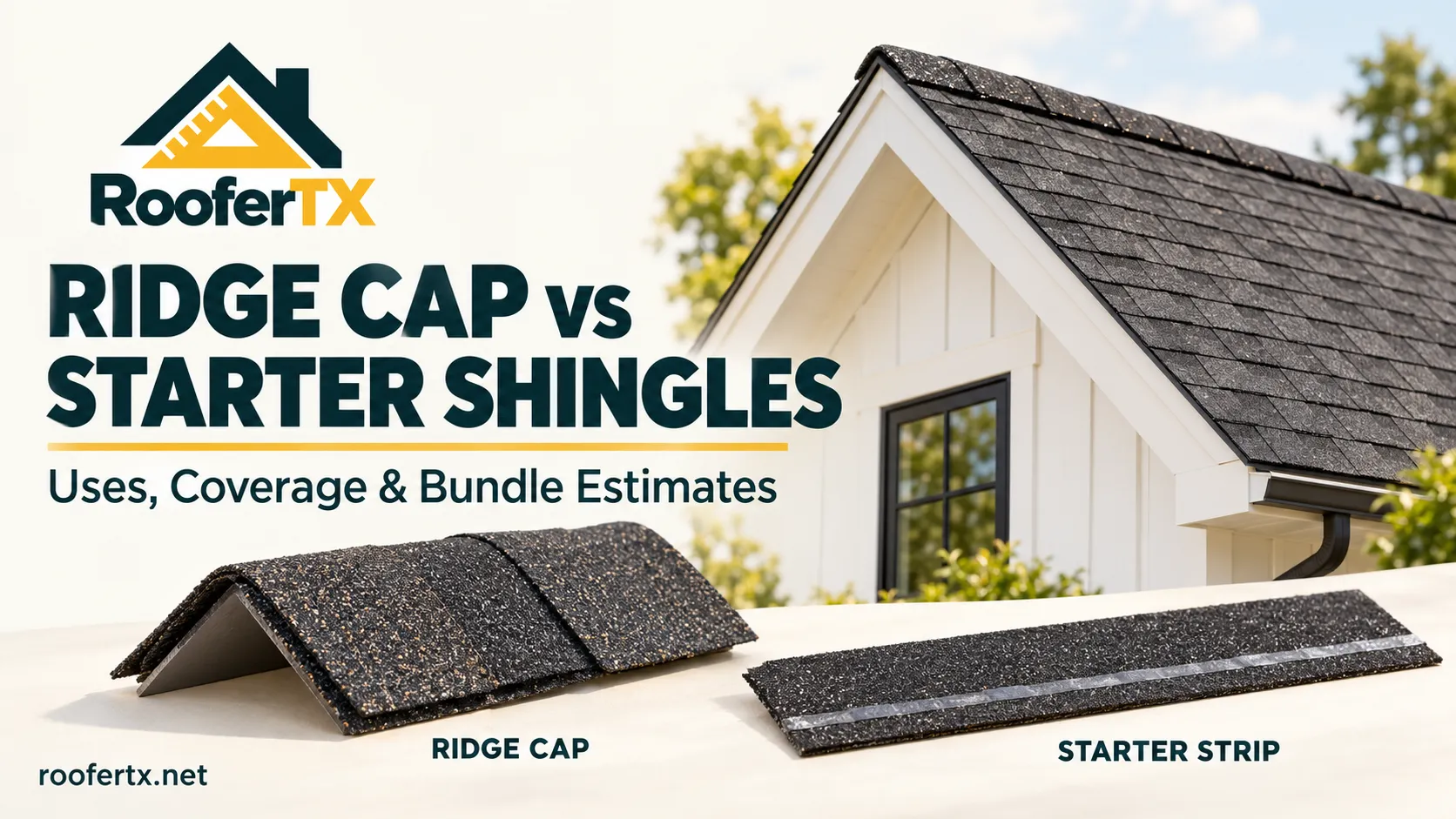
Ridge cap vs starter shingles is a comparison between two asphalt-roofing components that serve different locations. Starter shingles go beneath the field shingles at specified roof edges. Ridge cap shingles cover the roof’s hips and ridges.
They are not alternatives to one another. A roof may need both, and each requires its own measurements and product coverage.
If your estimate only lists “shingle bundles,” ask whether it includes field shingles, starter material, and hip-and-ridge caps. Separating these quantities makes the order easier to check.
Ridge Cap vs Starter Shingles: The Main Difference
Starter shingles support the roof-edge detail, while ridge caps protect and finish the joints where roof slopes meet.
Purpose-made starter products have sealant positioned for their intended edge application. Hip-and-ridge shingles are shaped or folded to cover the roof’s raised intersections. gaf.com
| Feature | Starter shingles | Ridge cap shingles |
|---|---|---|
| Main location | Eaves and specified rake edges | Ridges and hips |
| Main role | Provide the starter layer and help secure roof edges | Cover and finish raised roof intersections |
| Position | Beneath the edge of field shingles | Over the adjoining roof slopes |
| Measurement | Required edge length | Required ridge and hip length |
| Ordering basis | Published linear coverage per package | Published linear coverage at the specified exposure |
| Separate from field shingles? | Estimate separately | Estimate separately |
Neither quantity can be calculated accurately from roof area alone.
What Are Starter Shingles?
Starter shingles form part of the beginning edge detail of an asphalt-shingle roof. They sit beneath the field shingles rather than replacing the first visible course.
Their placement and sealant help reduce the risk of shingles lifting at exposed roof edges. Correct alignment and fastening remain important; buying a purpose-made product does not compensate for incorrect installation.
Eaves and Rakes Are Different Edges
An eave is the lower roof edge, often where a gutter runs.
A rake is the sloping edge at a gable end.
Record these lengths separately. Then check which edges require starter material under the selected roofing system.
Do not assume gutter length equals total starter length. A roof can have substantial rake edges without gutters.
What Are Ridge Cap Shingles?
Ridge cap shingles cover raised intersections between roof planes.
A ridge is usually the upper horizontal meeting line. A hip slopes downward along an outside corner where two roof planes meet.
A hip roof can therefore require considerably more cap material than its main ridge length suggests.
Ridge Caps Are Different from Ridge Vents
A ridge cap is a roofing component. A ridge vent is a ventilation component.
Where a shingle-over ridge vent is specified, compatible cap shingles finish the assembly above it. The vent and cap remain separate products with separate quantities.
Check compatibility, cap width, and fastening instructions for the selected combination.
Why Roof Area Does Not Determine Accessory Quantities
Two roofs can have the same surface area but different edge and ridge lengths.
A simple gable roof might have one main ridge. A similarly sized roof with hips, dormers, and several sections may need more cap material and more starter runs.
Keep these measurements separate:
- Field shingles: roof surface area.
- Starter material: specified eave and rake lengths.
- Hip-and-ridge caps: applicable hip and ridge lengths.
Use the Roof Shingle Calculator for field shingles, then calculate the accessories independently.
Measure Actual Sloping Lengths
For hips and rakes, use the actual roof length rather than a shorter plan-view projection.
Also distinguish hips from valleys. Both can appear as diagonal lines on a roof drawing, but valleys are inward drainage intersections and are not counted as hip-cap runs.
A clearly labeled roof sketch helps prevent ordering the right product for the wrong measurement.
Ridge Cap vs Starter Shingles: How to Calculate Bundles
The basic formula is:
Bundles required = round up [(required length × allowance factor) ÷ coverage per bundle]
Use the coverage for the exact product and application.
An allowance may cover cuts, damaged pieces, and specific starting or finishing details. It should reflect the project rather than being copied automatically from the field-shingle waste percentage.
Ridge Cap vs Starter Shingles: Separate the Measurements First
Create two totals before calculating bundles:
Starter length = required eaves + required rakes
Cap length = applicable ridges + applicable hips
Do not combine those totals. Even when both products are sold in bundles, their coverage can be very different.
Ridge Cap vs Starter Shingles: Worked Estimate
Assume a hypothetical project has:
| Measurement | Length |
|---|---|
| Eaves requiring starter | 120 ft |
| Rakes requiring starter | 80 ft |
| Total starter length | 200 ft |
| Ridges requiring caps | 50 ft |
| Hips requiring caps | 70 ft |
| Total cap length | 120 ft |
For this example, use:
- A 5% illustrative allowance for each component.
- 120 linear feet per starter bundle.
- 25 linear feet per cap bundle.
Starter calculation:
200 × 1.05 = 210 ft
210 ÷ 120 = 1.75 bundles
Round up to 2 starter bundles.
Cap calculation:
120 × 1.05 = 126 ft
126 ÷ 25 = 5.04 bundles
Round up to 6 cap bundles.
These coverage values are example inputs, not universal package sizes.
The example shows why rounding matters: five cap bundles would provide only 125 feet against the adjusted 126-foot requirement.
Use the Starter Shingle Calculator and Ridge Cap Calculator to check your separate quantities.
Why Bundle Coverage Changes Between Products
“One bundle” describes packaging, not a standard amount of installed coverage.
For example, GAF lists Pro-Start at approximately 120.33 linear feet per bundle. Its WeatherBlocker product can provide 50 or 100 linear feet, depending on whether the application uses full sheets or permitted split sheets.
That difference can materially change an order.
Before entering coverage into a calculator, confirm:
- The exact product.
- The required application.
- Whether published coverage assumes splitting.
- Whether the package instructions match the selected field shingles.
Ridge-Cap Exposure Also Affects Coverage
Exposure is the portion of each installed cap piece left uncovered by the next piece.
For a simplified coverage check:
Linear feet = usable cap pieces × specified exposure in inches ÷ 12
Starting and finishing details may require additional pieces.
Do not increase exposure to stretch a bundle farther. Follow the specified application rather than changing the installation to match the quantity purchased.
Can Regular Shingles Replace Starter or Ridge Products?
Do not assume that any leftover shingle can serve either purpose.
Some roofing instructions permit specific cut-shingle details. Other systems call for designated accessories. Check the instructions for the actual roofing products.
In particular, do not assume an architectural field shingle can be cut or bent into a suitable ridge cap.
Also distinguish a starter piece used to begin a hip or ridge run from the starter-strip product used at roof edges. Similar wording does not make the components interchangeable.
Avoid Double-Counting in Your Estimate
Separating materials improves clarity, but the same material should not be counted twice.
If purpose-made starter and cap products are ordered separately, do not also assume the field-shingle allowance must supply those same components.
If an approved detail uses field shingles to make an accessory, show the allocation explicitly.
A useful estimate records:
| Item | Quantity basis |
|---|---|
| Field shingles | Roof area plus appropriate field allowance |
| Starter product | Required edge length and package coverage |
| Hip-and-ridge product | Required cap length and package coverage |
| Ridge vent | Specified vent length |
| Fasteners and accessories | Selected installation requirements |
The Roofing Estimate Builder can help organize those line items.
What to Ask Before Approving the Order
Ask the contractor or supplier to confirm:
- Which starter product is included?
- Does the quantity include the required rake edges?
- Which hip-and-ridge product and color are specified?
- Are all hips included in the cap measurement?
- Does the coverage match the required application?
- Are ventilation components listed separately?
- Have compatible leftover materials already been deducted?
For the cap product, check appearance as well as compatibility. Its visible profile can affect the finished roof’s look.
Frequently Asked Questions
Are starter shingles and ridge caps the same?
No. Starter shingles serve roof-edge details, while ridge caps cover hips and ridges. They have different locations and quantity requirements.
Do starter shingles replace the first row of regular shingles?
No. The starter layer sits beneath the first field-shingle course at the applicable edge.
Should I count hips when ordering ridge caps?
Yes, when the specified hip-and-ridge product is used on those hips. Counting only the horizontal ridge can leave the order short.
Do I subtract ridge-vent length from ridge-cap length?
Usually not for a shingle-over ridge vent, because compatible cap shingles still cover that vent. Check the selected vent system.
How many feet does one bundle cover?
It depends on the product and application. Use the manufacturer’s published linear coverage rather than a generic bundle assumption.
Can I use leftover bundles?
Only if they are the correct, compatible product and remain suitable for installation. Deduct usable stock after calculating the total requirement.


Discussion (1)