
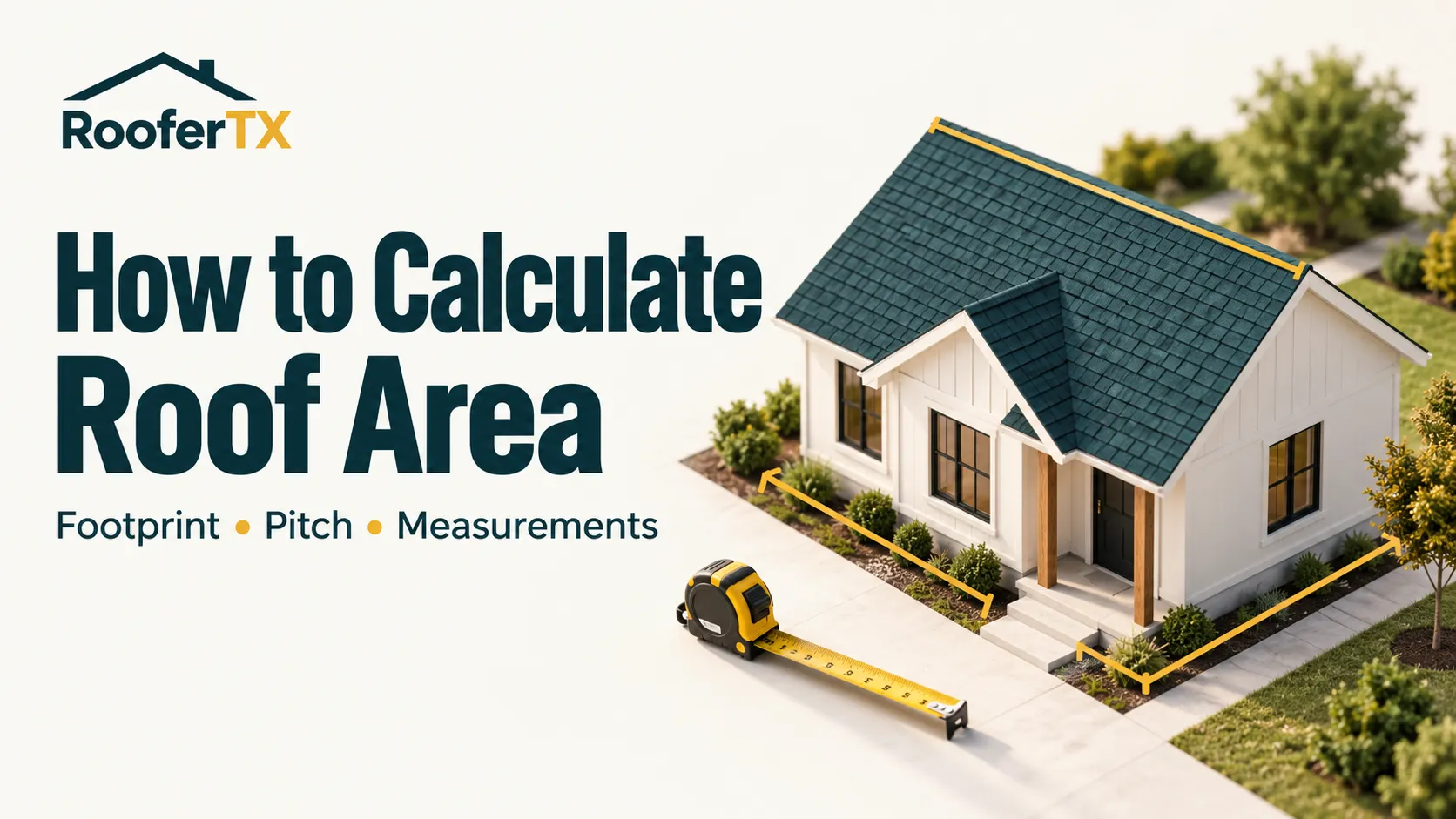
Learning how to calculate roof area starts with two measurements: the roof’s horizontal footprint and its pitch. Include overhangs in the footprint, then apply a pitch multiplier to find the actual sloped surface area.
Roof surface area = horizontal roof footprint × pitch multiplier
For example, a roof footprint of 1,500 square feet with a 6/12 pitch has approximately 1,677 square feet of roof surface, before adding material waste.
This guide explains the calculation with a worked example, a pitch table and practical checks. You can also enter your measurements into the RooferTX Roof Area Calculator.
Understand Roof Area Before You Measure
The building footprint, roof footprint and roof surface area describe different things. Mixing them up can lead to an inaccurate estimate.
| Measurement | Meaning |
|---|---|
| Building footprint | The horizontal area within the building’s exterior outline |
| Roof footprint | The roof’s horizontal projection, including overhangs |
| Roof surface area | The actual area of the sloping roof planes |
A pitched roof has more surface area than its horizontal footprint. The steeper the pitch, the greater that difference.
Your home’s advertised square footage is not a reliable roof measurement. It may include multiple floors and exclude roofed areas such as a garage or porch.
How to Calculate Roof Area in Four Steps
For a simple roof with one consistent pitch, measure the horizontal outline, identify the pitch, calculate the multiplier and multiply the two values.
Use reliable drawings or a roof measurement report where available. You do not need to climb onto a roof to work through this calculation.
1. Measure the Roof Footprint, Including Overhangs
For a rectangular roof outline:
Horizontal roof footprint = length × width
Suppose a building measures 48 feet long and 28 feet wide. Its roof extends 1 foot beyond the walls on all four sides.
Add those horizontal overhangs to the building dimensions:
- Roof length: 48 + 1 + 1 = 50 feet
- Roof width: 28 + 1 + 1 = 30 feet
The horizontal roof footprint is:
50 × 30 = 1,500 square feet
If your measurements already extend to the outside roof edges, the overhangs are already included. Do not add them again.
For an L-shaped outline, divide the footprint into non-overlapping rectangles, calculate each area and add them together.
2. Identify the Pitch of Each Roof Section
Roof pitch describes the rise compared with the horizontal run.
A 6/12 pitch means the roof rises 6 inches for every 12 inches of horizontal distance. It does not mean the roof angle is 6 degrees.
Check plans or a verified measurement instead of estimating the pitch by appearance.
If you have rise and run measurements, the Roof Pitch Calculator in the RooferTX roofing tools directory can help with the conversion.
3. Calculate the Pitch Multiplier
The pitch multiplier converts the horizontal footprint into sloped surface area.
Pitch multiplier = √[1 + (rise ÷ run)²]
For a 6/12 pitch:
√[1 + (6 ÷ 12)²] = 1.118034
Use the table below for common pitches. The displayed multipliers are rounded.
| Roof pitch | Pitch multiplier |
|---|---|
| 2/12 | 1.0138 |
| 3/12 | 1.0308 |
| 4/12 | 1.0541 |
| 5/12 | 1.0833 |
| 6/12 | 1.1180 |
| 8/12 | 1.2019 |
| 10/12 | 1.3017 |
| 12/12 | 1.4142 |
These factors account for slope only. They do not include cuts, waste, overlaps or package rounding.
4. Multiply the Footprint by the Pitch Multiplier
Using the full multiplier for our example:
1,500 × 1.118034 = 1,677.05 square feet
The roof surface area is approximately 1,677 square feet before waste.
Once you understand how to calculate roof area manually, checking calculator results becomes easier. Confirm that the tool uses the same dimensions, pitch and waste setting as your own calculation.
How to Calculate Roof Area for a Gable Roof
A simple gable roof has two main sloping sides. You can calculate its area using the full horizontal footprint or by measuring each roof plane separately.
For the same 50-foot-long roof with a 30-foot horizontal span, each side has a horizontal run of 15 feet.
At a 6/12 pitch:
Sloped length = 15 × 1.118034 = 16.7705 feet
The surface area of one side is approximately:
50 × 16.7705 = 838.53 square feet
Adding both sides, using unrounded values, gives approximately 1,677.05 square feet.
How to Calculate Roof Area Without Double Counting
When you multiply the full roof footprint by the pitch multiplier, both sides of this gable roof are already included.
Do not multiply that result by two.
Use one method consistently:
- Footprint method: Multiply the complete horizontal projection by the pitch multiplier.
- Roof-plane method: Calculate each actual sloped surface and add the areas.
Also, if you already measured a roof plane’s actual sloped dimensions, do not apply the pitch multiplier again.
Calculate Different Roof Pitches Separately
A porch, extension or garage may have a different slope from the main roof. Applying one multiplier to every section can produce the wrong total.
Here is how to calculate roof area when two separate, non-overlapping sections have different pitches:
| Section | Horizontal footprint | Pitch | Roof surface area |
|---|---|---|---|
| Main roof | 1,200 sq ft | 6/12 | 1,341.64 sq ft |
| Porch roof | 300 sq ft | 3/12 | 309.23 sq ft |
| Total | 1,500 sq ft | Mixed | 1,650.87 sq ft |
Multiply each horizontal area by its own pitch factor, then add the results.
For dormers, intersecting roofs or roofs that change slope, use a detailed section-by-section measurement plan. A basic building outline may not represent every exposed roof surface correctly.
Convert Square Feet into Roofing Squares
A roofing square equals 100 square feet of roof area. Divide the total surface area by 100 to convert square feet into squares. GAF uses this same conversion in its roofing measurement guidance.
For the original example:
1,677.05 ÷ 100 = 16.7705 roofing squares
That is approximately 16.77 squares before waste.
Keep the calculated area separate from the quantity you order. Bundles, rolls and panels have product-specific coverage, so the final purchase quantity requires another step.
Keep Material Waste Separate from Roof Area
Understanding how to calculate roof area helps you establish the base measurement. A waste allowance is added afterward for material planning.
For illustration, assume a 10% waste allowance:
Waste-adjusted area = roof surface area × 1.10
1,677.05 × 1.10 = 1,844.76 square feet
Your estimate should show both numbers:
- Measured roof surface: approximately 1,677 square feet.
- Planning quantity with the example allowance: approximately 1,845 square feet.
The 10% figure is an example, not a rule for every roof. Choose the allowance based on the material, layout, cutting requirements and supplier or contractor guidance.
Starter strips, ridge caps and flashing may need separate measurements. Do not assume that a general waste allowance covers every accessory.
Use the Same Formula for Square Metres
The method also works in metric units because the pitch multiplier has no units.
For a horizontal roof footprint measuring 12 metres by 8 metres:
12 × 8 = 96 m²
At a 6/12 pitch:
96 × 1.118034 = 107.33 m²
The roof surface area is approximately 107.33 square metres before waste.
Keep all length measurements in the same unit system. Do not multiply a length in feet by a width in metres without converting one first.
Common Mistakes That Change Your Estimate
When checking how to calculate roof area for your own property, review these common errors.
Using living space instead of the footprint. A two-storey home with 2,400 square feet of living space does not necessarily have a roof footprint of that size.
Missing or duplicating overhangs. Add them only when your starting dimensions stop at the building walls.
Using one pitch for different sections. Check the main roof, porch and additions separately.
Applying slope twice. Actual sloped dimensions already account for the roof angle.
Combining waste with measured area. Show the base area and allowance separately so quantities are easier to compare.
Rounding too early. Keep extra decimal places during the calculation. Round the final area and then calculate whole material packages using the product’s coverage.
Check Your Estimate Before Ordering
Knowing how to calculate roof area gives you a useful starting point for material planning. The result is only as reliable as the footprint, pitch and section measurements you enter.
Use the RooferTX Roof Area Calculator to check your figures. Then confirm the roof measurements, selected product coverage and accessory quantities before placing an order.
Frequently Asked Questions
How Do I Calculate Roof Area from a Building Footprint?
First, include the roof’s horizontal overhangs in the footprint. Multiply that area by the pitch multiplier. If roof sections have different pitches, calculate each section separately and add the results.
Is Roof Area the Same as House Square Footage?
No. House square footage usually describes interior floor space. Roof area depends on the roof outline, overhangs, slope and separate roof sections.
How Much Roof Area Does a 1,500-Square-Foot Footprint Have?
With a uniform 6/12 pitch, it has approximately 1,677 square feet of roof surface before waste. This assumes the horizontal footprint already includes overhangs.
Do I Double the Calculation for a Gable Roof?
No, not when you use the full horizontal roof footprint and apply the pitch multiplier. Double a single roof plane’s area only if the other plane has identical dimensions.
Can This Method Work for a Hip Roof?
Yes. If all roof planes share the same pitch, apply that multiplier to their combined horizontal projection. Calculate planes with different pitches separately. The number of roof planes alone does not determine surface area.
Can I Calculate Roof Area Without Knowing the Pitch?
You can measure the horizontal footprint, but you need the pitch to convert it into sloped surface area using this method. An alternative is to obtain the actual surface dimensions of each roof plane from a reliable measurement report.
Does Calculated Roof Area Include Waste?
No. The footprint-and-pitch calculation gives the roof surface area. Add a suitable material allowance separately, then account for product coverage and whole-package ordering.


Discussion (6)