
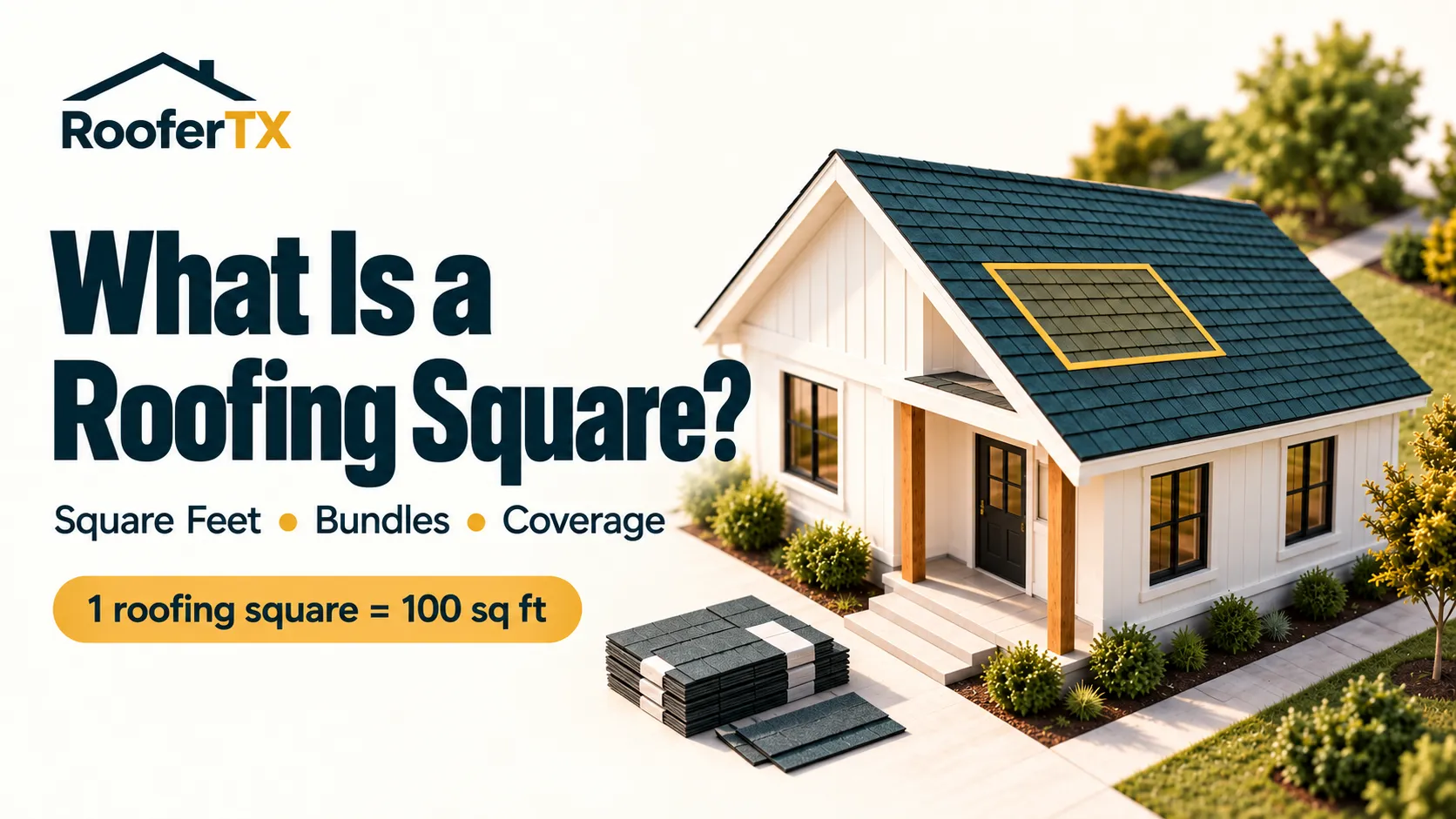
What is a roofing square? A roofing square is a unit of area equal to 100 square feet, or approximately 9.29 square metres. Roofers use it to describe roof size and material coverage. A roof measuring 2,000 square feet contains 20 roofing squares before any waste allowance.
A roofing square is not a single shingle, a bundle or a particular roof shape. It is simply a convenient way to express a larger surface area.
This guide explains how to convert roof measurements, understand bundle quantities and keep material waste separate. You can check your figures with the RooferTX Roofing Square Calculator.
What Is a Roofing Square in Practical Terms?
Imagine a section of roof surface measuring 10 feet by 10 feet.
10 × 10 = 100 square feet = 1 roofing square
The section does not actually need to be square-shaped. A rectangular roof surface measuring 5 feet by 20 feet also covers 100 square feet.
The measurement describes area, regardless of shape.
| Term | Meaning |
|---|---|
| Square foot | An area measuring 1 foot by 1 foot |
| Roofing square | 100 square feet of roof surface |
| Shingle bundle | A package with product-specific coverage |
| Waste allowance | Extra material planned for cuts and layout losses |
Keeping these terms separate helps you understand why a roof’s measured squares and the number of packages ordered may differ.
What Is a Roofing Square Compared with a Shingle Bundle?
A roofing square is a fixed area. A bundle is a package of shingles.
Many common asphalt shingles are packaged at about three bundles per square, but that is not universal. The selected product’s stated coverage determines the correct bundle count. GAF explains this distinction in its guide to shingle bundles and roofing squares.
Check the package label or product data before ordering. Do not assume every bundle covers the same area.
What Is a Roofing Square When the Package Coverage Changes?
Suppose one product requires three bundles to cover 100 square feet, while another requires four.
Both cover one roofing square when the specified number of bundles is installed according to the manufacturer’s instructions.
The area unit stays the same. Only the packaging and coverage change.
How to Convert Square Feet into Roofing Squares
Divide the measured roof surface area by 100.
Roofing squares = roof surface area in square feet ÷ 100
For example:
2,350 ÷ 100 = 23.5 roofing squares
There is nothing wrong with a decimal result. A measured roof can contain 23.5 squares, 18.72 squares or another fractional amount.
Keep that figure until you calculate the waste allowance and actual material packages.
Square Feet to Roofing Squares Chart
| Roof surface area | Roofing squares before waste |
|---|---|
| 500 sq ft | 5 |
| 750 sq ft | 7.5 |
| 1,000 sq ft | 10 |
| 1,250 sq ft | 12.5 |
| 1,500 sq ft | 15 |
| 1,800 sq ft | 18 |
| 2,000 sq ft | 20 |
| 2,350 sq ft | 23.5 |
| 2,500 sq ft | 25 |
| 3,000 sq ft | 30 |
To reverse the conversion, multiply roofing squares by 100.
23.5 squares × 100 = 2,350 square feet
Start with Roof Surface Area, Not House Floor Area
When homeowners ask “what is a roofing square?”, the next mistake is often using their home’s advertised square footage.
Floor area and roof surface area are different measurements.
A property listing may include multiple floors. The roof measurement must account for the actual roof outline, overhangs, slope and separate roof sections.
For example, a two-storey home with 2,000 square feet of living space does not automatically have 20 squares of roofing.
Where Roof Pitch Fits into the Calculation
If your starting measurement is a horizontal footprint, you must account for slope before converting the result into squares.
For a simple roof with a uniform pitch:
Roof surface area = horizontal roof footprint × pitch multiplier
Then:
Roofing squares = roof surface area ÷ 100
Suppose the roof’s horizontal footprint, including overhangs, is 1,500 square feet and the pitch is 6/12.
The pitch multiplier is approximately 1.118034:
1,500 × 1.118034 = 1,677.05 square feet
1,677.05 ÷ 100 = 16.7705 roofing squares
The result is approximately 16.77 squares before waste, rather than 15 squares.
Read how to calculate roof area for the full measurement process. If the slope notation is unfamiliar, our roof pitch explained guide covers rise, run and angle.
Already measured the actual sloped roof surfaces? Do not apply the pitch multiplier again.
Worked Example: From Roof Area to Material Quantity
Understanding what is a roofing square becomes more useful when you follow the calculation through to an order.
Assume you have:
- Measured roof surface: 2,350 square feet.
- Illustrative waste allowance: 10%.
- Selected shingle coverage: three bundles per square.
The coverage is an example assumption. Replace it with your product’s actual specification.
Step 1: Calculate the Measured Squares
2,350 ÷ 100 = 23.5 squares
This is the physical roof area expressed in roofing squares.
Step 2: Add the Waste Allowance
23.5 × 1.10 = 25.85 squares
The same calculation in square feet is:
2,350 × 1.10 = 2,585 square feet
The roof has not become larger. You have added a material allowance for the planned installation.
Step 3: Convert the Allowance into Bundles
For the example product:
25.85 × 3 = 77.55 bundles
Because you buy whole bundles, round the final quantity up:
Order quantity: 78 bundles
This example covers field shingles only. It does not establish the quantities of starter strips, ridge caps, flashing or other accessories.
| Calculation stage | Result |
|---|---|
| Measured roof surface | 2,350 sq ft |
| Measured roofing squares | 23.5 |
| Planning quantity with 10% allowance | 25.85 squares |
| Calculated bundles at three per square | 77.55 |
| Whole-bundle quantity | 78 |
Use the RooferTX Roof Shingle Calculator to work through your own area, product coverage and waste allowance.
Does a Roofing Square Include Waste?
No. One roofing square always represents 100 square feet. Waste is a separate allowance applied to the quantity being purchased.
However, an estimate might list either measured roof squares or waste-adjusted material squares. Ask which figure it uses.
For example, an estimate showing 25.85 squares could refer to a 23.5-square roof with a 10% allowance.
Do not add waste again if it is already included.
The 10% allowance used above is illustrative. The appropriate allowance depends on the material, roof layout, cuts and installation approach. Confirm it with the supplier or contractor.
How to Convert Square Metres into Roofing Squares
One roofing square equals 9.290304 square metres.
To convert metric roof area:
Roofing squares = square metres ÷ 9.290304
For a roof surface measuring 150 m²:
150 ÷ 9.290304 ≈ 16.15 squares
To convert in the opposite direction:
Square metres = roofing squares × 9.290304
Therefore:
20 squares × 9.290304 = 185.80608 m²
Rounded to two decimal places, 20 roofing squares equal 185.81 m².
The roofing square conversion tool can help you compare imperial and metric measurements without changing the underlying area.
How to Read Squares on a Roofing Estimate
Knowing what is a roofing square helps you compare quantities, but the unit alone does not explain everything included in a quote.
Check whether the estimate identifies:
- Measured squares: the actual roof surface area.
- Material squares: the quantity after any allowance.
- Product coverage: the bundles, panels or rolls required.
- Accessories: starter strips, ridge caps, flashing and other components.
- Work included: installation, removal, disposal and any separately priced repairs.
Two estimates can show the same number of squares but include different materials and work.
Also, roofing squares measure area—not weight. A square of one roofing product may weigh much more than a square of another.
Common Mistakes to Avoid
Treating one square as one bundle.
A square is 100 square feet. Bundle coverage depends on the product.
Using the house’s living area.
Calculate the roof surface before converting it into squares.
Rounding the measured squares too early.
Keep decimal values through the calculation. Round at the purchasing stage according to package sizes.
Adding waste twice.
Check whether the figure you received already includes an allowance.
Using gross material dimensions as installed coverage.
For materials with overlaps, use the manufacturer’s stated effective coverage.
Assuming squares include every accessory.
Edge, ridge and valley components often require separate length measurements.
Before ordering, keep a clear record of the measured area, allowance and product coverage. That makes the final quantity easier to check.
Frequently Asked Questions
What Is a Roofing Square Equal To?
A roofing square equals 100 square feet of roof surface, or approximately 9.29 square metres. It is a unit of area rather than a physical package.
How Many Roofing Squares Are in 2,000 Square Feet?
A measured roof surface of 2,000 square feet contains 20 roofing squares before waste. Divide 2,000 by 100 to get the result.
How Many Bundles Are in a Roofing Square?
Many common asphalt shingles require about three bundles per square, but the number varies by product. Use the manufacturer’s stated coverage rather than assuming a universal bundle count.
Can a Roof Measure 23.5 Squares?
Yes. Roofing squares can include decimals. A 23.5-square roof has 2,350 square feet of surface area.
Does Roof Pitch Change the Size of a Roofing Square?
No. One square always equals 100 square feet. Pitch changes the total roof surface area over a given horizontal footprint, which changes the number of squares.
Do Two Layers of Shingles Double the Roof’s Squares?
The roof surface area stays the same. A 20-square roof with two shingle layers is still a 20-square roof, but removing both layers can increase removal work and debris. Record the area and layer count separately.
Is a Roofing Square Used Only for Asphalt Shingles?
No. Roofing squares can express the area of different roof coverings. The conversion into packages, panels or rolls must still use the selected product’s effective coverage.
How Many Square Metres Are in 10 Roofing Squares?
Ten roofing squares equal 92.90304 m², or approximately 92.90 m². Multiply 10 by 9.290304 to make the conversion.


Discussion (1)