
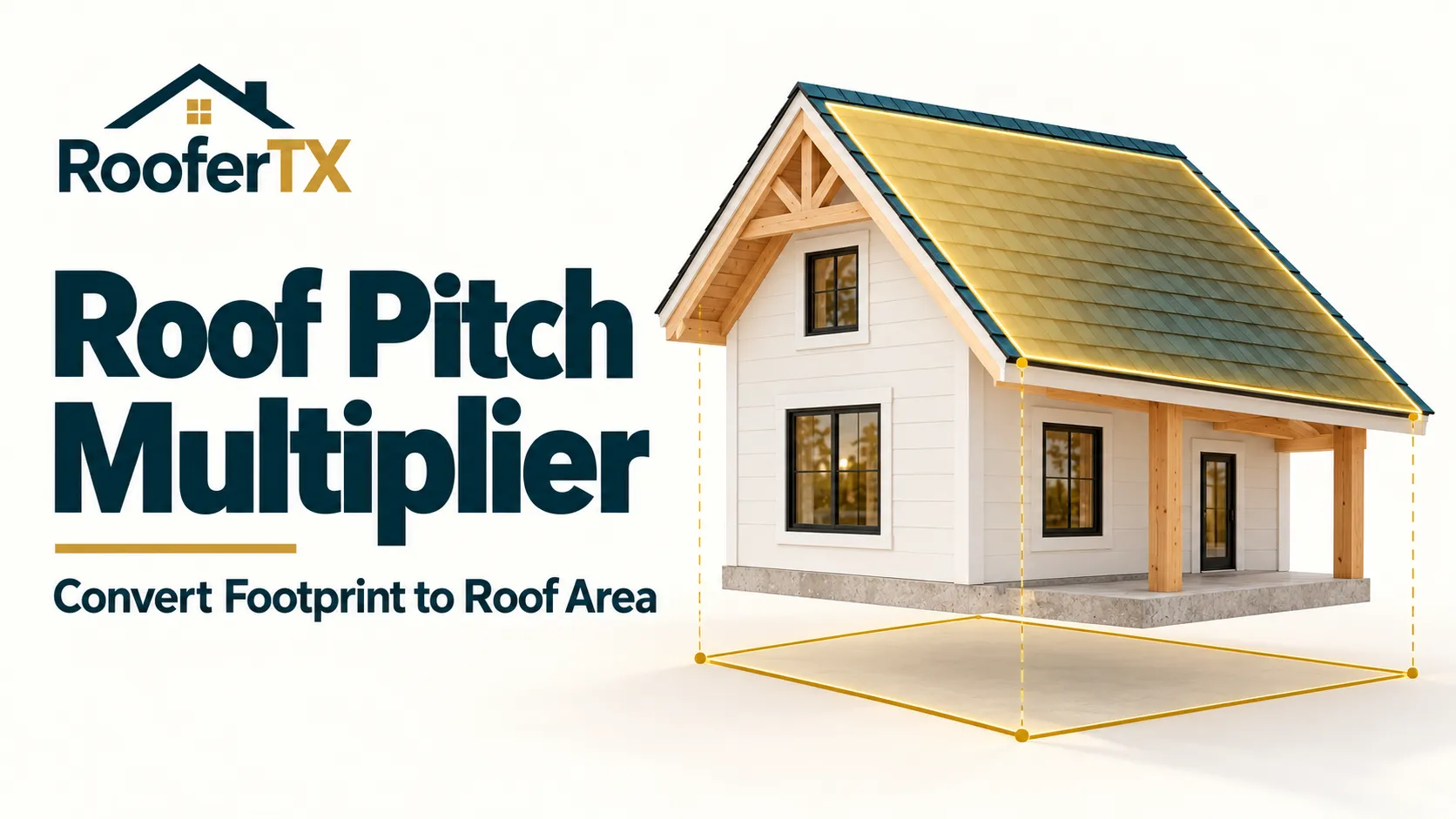
A roof pitch multiplier converts a roof’s horizontal projected area into its actual sloped surface area. It accounts for the extra surface created by the roof’s incline.
For example, a 6/12 roof pitch has a multiplier of approximately 1.1180. A horizontal roof footprint of 1,500 square feet therefore represents about 1,677 square feet of sloped roofing, before waste.
The calculation is:
Sloped roof area = horizontal projected area × roof pitch multiplier
The important part is choosing the correct starting measurement. Use the multiplier for horizontal projections—not for dimensions already measured along the roof surface.
What Is a Roof Pitch Multiplier?
A roof pitch multiplier, also called a slope factor or roof area factor, describes the relationship between a sloped roof plane and its horizontal projection.
Imagine looking directly down at a roof. The area it occupies in that overhead view is its horizontal projection. The actual surface is larger because it slopes upward.
The multiplier expresses that difference.
| Measurement | What it describes |
|---|---|
| Horizontal projected area | The roof plane’s footprint viewed from above |
| Sloped surface area | The actual inclined area to be covered |
| Pitch multiplier | The factor that converts the first area into the second |
A multiplier of 1.1180 means the sloped area is approximately 11.80% larger than the horizontal projection.
It does not mean you should order 11.80% extra for installation waste. Slope adjustment and waste are separate calculations.
Roof Pitch Multiplier Formula
For a pitch written as X/12, use:
Multiplier = √[1 + (X ÷ 12)²]
Here, X is the vertical rise for every 12 units of horizontal run.
For a 6/12 roof:
Multiplier = √[1 + (6 ÷ 12)²]
= √(1 + 0.25)
= √1.25
≈ 1.118034
The multiplier has no unit. It works with square feet, square metres or another consistent area unit.
Calculate a Roof Pitch Multiplier from Rise and Run
If your measurements are not expressed as X/12, use the general formula:
Multiplier = √[1 + (rise ÷ run)²]
For example, a rise of 2 metres over a horizontal run of 4 metres gives:
√[1 + (2 ÷ 4)²] ≈ 1.118034
Use the same unit for rise and run. Convert measurements before dividing if one is in inches and the other is in feet.
Roof Pitch Multiplier Check: Use Horizontal Run
The run must be horizontal. It is not the sloping rafter length.
For a right triangle with a 4-metre run and a 2-metre rise, the diagonal is approximately 4.4721 metres:
4.4721 ÷ 4 ≈ 1.1180
That provides a useful check: the multiplier compares the sloped distance with its corresponding horizontal distance.
For more detail on the different ways to describe slope, read our roof pitch explained guide.
Roof Pitch Multiplier Chart
Use this chart for common roof pitches. Values are rounded to four decimal places; retain more precision when calculating large areas.
| Roof pitch | Roof pitch multiplier | Area above horizontal footprint |
|---|---|---|
| 1/12 | 1.0035 | 0.35% |
| 2/12 | 1.0138 | 1.38% |
| 3/12 | 1.0308 | 3.08% |
| 4/12 | 1.0541 | 5.41% |
| 5/12 | 1.0833 | 8.33% |
| 6/12 | 1.1180 | 11.80% |
| 7/12 | 1.1577 | 15.77% |
| 8/12 | 1.2019 | 20.19% |
| 9/12 | 1.2500 | 25.00% |
| 10/12 | 1.3017 | 30.17% |
| 11/12 | 1.3566 | 35.66% |
| 12/12 | 1.4142 | 41.42% |
The percentage in the final column is calculated as:
Additional area percentage = (multiplier − 1) × 100
These are geometric conversions, not recommendations for roofing materials or installation methods.
Worked Example: Convert a 1,500-Square-Foot Footprint
Suppose a simple roof has:
- A horizontal projected length of 50 feet.
- A horizontal projected width of 30 feet.
- A consistent pitch of 6/12.
- Overhangs already included in those dimensions.
First, calculate the horizontal area:
50 × 30 = 1,500 square feet
Next, apply the multiplier:
1,500 × 1.118034 ≈ 1,677.05 square feet
The net sloped roof area is approximately 1,677 square feet.
This is about 16.77 roofing squares, because one roofing square equals 100 square feet.
Do You Multiply Again for Both Sides of a Gable Roof?
No—not when the footprint already includes the horizontal projection of both roof slopes.
In this example, the full 50-by-30-foot projection covers both sides. Applying their shared multiplier once gives the combined surface area.
You can calculate the two planes separately instead, but each must use only its own projected area.
Our guide on how to calculate roof area explains the footprint method in more detail.
How to Calculate Roofs with Different Pitches
A roof with a shallow porch and a steeper main section needs separate calculations.
Consider these hypothetical, non-overlapping projected areas:
| Section | Horizontal area | Pitch | Multiplier | Sloped area |
|---|---|---|---|---|
| Main roof | 1,200 sq ft | 6/12 | 1.118034 | 1,341.64 sq ft |
| Porch roof | 240 sq ft | 3/12 | 1.030776 | 247.39 sq ft |
| Total | 1,440 sq ft | — | — | 1,589.03 sq ft |
Calculate each section first, then add the sloped areas.
Do not average the two pitches and apply that average to the whole footprint. The sections differ in size, and the multiplier does not change linearly with pitch.
IKO’s roofing estimation guide describes grouping horizontal roof areas by slope and converting them before combining the results. iko.com
For roofs at different levels, also check whether an upper roof hides a lower surface in the overhead view. A single outline may not capture every roof plane.
When You Should Not Apply the Multiplier
A roof pitch multiplier is unnecessary when your measurements already describe the actual sloped surface.
Suppose a rectangular roof plane measures:
- 40 feet along the eave
- 18 feet up the slope
Its surface area is:
40 × 18 = 720 square feet
That is already the sloped area. Applying a pitch multiplier would inflate the result.
The same caution applies to measurement reports. Check whether a reported area is labelled projected area, plan area or roof surface area before adjusting it.
| Starting information | Apply a pitch multiplier? |
|---|---|
| Horizontal projection of a known roof plane | Yes |
| Length and width measured within the roof plane | No |
| Reported sloped roof surface area | No |
| Home’s advertised living area | Not directly; establish the roof footprint first |
Overhangs and Waste Need Separate Treatment
The multiplier only adjusts for slope. It does not add roof sections or overhangs missing from your starting dimensions.
For example, a building measuring 40 by 30 feet with a 1-foot horizontal roof overhang on all four sides has a projected roof footprint of:
(40 + 2) × (30 + 2) = 1,344 square feet
Use that roof footprint rather than the 1,200-square-foot wall footprint.
Add Waste After Calculating Net Surface Area
Using the earlier result of 1,677.05 square feet, a hypothetical 10% allowance would produce:
1,677.05 × 1.10 ≈ 1,844.76 square feet
The 10% is an example, not a universal recommendation. Choose the allowance according to the roof layout, material and installation requirements.
Keep the figures separate:
- Horizontal projected area: 1,500 sq ft
- Net sloped roof area: 1,677.05 sq ft
- Planning quantity with the example allowance: 1,844.76 sq ft
Product coverage and package rounding still need to be checked before ordering.
Using the RooferTX Calculators
Use the Roof Pitch Calculator when you need to find a multiplier from rise and run, an X/12 pitch or an angle. It displays the slope multiplier alongside the pitch, angle and slope percentage. RooferTX
Then use the Roof Area Calculator to calculate the projected sections and their sloped areas.
Before entering your measurements, confirm three things:
- Whether your dimensions are horizontal or already sloped.
- Whether overhangs are included.
- Whether each section has the same pitch.
Once you have the net area, the Roof Shingle Calculator can help convert it into a product-based quantity estimate.
Frequently Asked Questions
What Is the Roof Pitch Multiplier for a 6/12 Roof?
The multiplier is approximately 1.1180. Multiply the horizontal projected area by this factor to calculate the corresponding sloped area before waste.
Is a 50% Roof Slope the Same as 50% More Roof Area?
No. A 50% slope means the rise is half the horizontal run, equivalent to 6/12 pitch. Its multiplier is approximately 1.1180, so its surface area is about 11.80% greater than its horizontal projection.
What Is the Multiplier for a 4/12 Roof?
A 4/12 roof has a multiplier of approximately 1.0541. A 1,000-square-foot horizontal projection therefore corresponds to about 1,054.09 square feet of sloped surface.
Can You Calculate the Multiplier from Degrees?
Yes. If the angle is measured above horizontal:
Multiplier = 1 ÷ cos(angle)
Make sure your calculator is in degree mode. At 45 degrees, the multiplier is approximately 1.4142.
Does the Multiplier Work for Hip Roofs?
Yes, for each roof plane’s horizontal projection and actual pitch. A single shared multiplier can be used when every included plane has the same pitch and all projected areas have been accounted for correctly.
Can You Divide by the Multiplier to Find the Footprint?
Yes. For a known, uniform slope:
Horizontal projected area = sloped area ÷ multiplier
For example, 1,118.03 square feet of surface at 6/12 pitch corresponds to approximately 1,000 square feet of horizontal projection.
Does a Roof Pitch Multiplier Include Waste?
No. It describes geometry only. Calculate waste, product coverage and package quantities separately after establishing the net roof surface area.